#law· 9 min readLire en français
Reproducing video game character outfits: what intellectual property law says
Mario's cap, Sora's shoes or the iconic outfits of our favourite characters: what does intellectual property really protect behind these recognisable elements? From cosplay to skins designed by luxury houses, this article reviews the rights at stake and what those who reproduce these outfits risk.

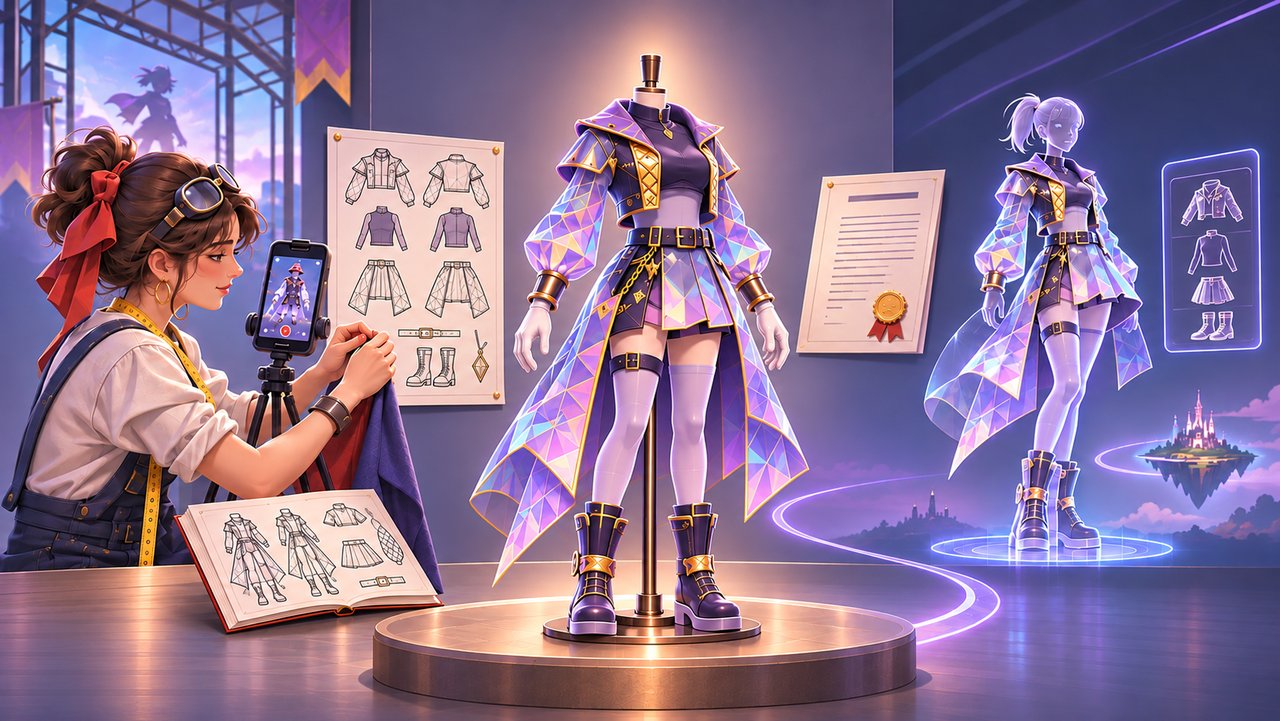
A few pieces of costume are often enough to recognise a video game character. Taken on their own, Mario’s cap or Sora’s big yellow shoes immediately point to their franchise. They are therefore valuable to rights holders, and tempting for those who reproduce them: cosplayers, content creators and fashion brands.
The legal question is twofold: what does intellectual property actually protect in an outfit, and what happens when it is copied, identically or almost, without the franchise owner’s consent?
The first part identifies the rights that can be relied on (copyright, designs, trademarks and, failing those, an action for free-riding). The second examines concrete reproductions, first by fans, then by brands in video games and virtual worlds.
I. The legal bases for protecting a character’s outfit
Three rights can protect a character’s outfit, and they can be combined. The fame of a costume is not, on its own, enough to protect it.
A. Copyright: the character and their costume as an original creation
Copyright arises from the mere act of creation, without registration, and covers all works of the mind, whatever their kind, form of expression, merit or purpose (Art. L. 112-1 of the French Intellectual Property Code, CPI).
A fictional character can therefore enjoy copyright protection as long as it is an original work. In France, protection has long been granted to characters such as Tarzan1, and originality is assessed as a whole, taking into account in particular the character’s physical features and attitudes2. In the United States, judges have even held that the Batmobile is a character protectable by copyright3.
In a video game, the outfit is part of the character’s appearance: reproducing it faithfully amounts to copying part of its graphic form. The CPI also protects creations of the seasonal clothing and adornment industries, including couture, fashion, footwear and leather goods (Art. L. 112-2, 14°).
Protection is not automatic, however: the outfit, or the combination of its elements, must reflect free and creative choices. In Mio/Konektra of 4 December 2025, the CJEU confirmed that works of applied art are subject to the same originality test as other works, with no higher threshold. Elements dictated by function are disregarded, and infringement requires a recognisable taking of the creative elements, not a mere overall resemblance4.
The burden of proof lies with the claimant: it must identify the features of the work that bear the imprint of the author’s personality5. A franchise must therefore be able to explain why the combination copied is creative, and not merely that it is recognisable.
A generic top and trousers are therefore not protected in themselves. What is protected is the original combination, when it is recognisably reproduced.
B. Industrial property and free-riding: designs, trademarks, unfair competition
The appearance of a product or part of a product can be protected as a design, defined by “its lines, contours, colours, shape, texture or materials” (Art. L. 511-1 CPI), provided it is new and has individual character (Art. L. 511-2). For video games, the EU legislature now specifies that the appearance of the game and its characters, as well as screens, icons and graphical interfaces, can be protected6.
These rights can be combined with copyright, but their conditions and infringement tests differ. A registered design whose protection has expired may still be protected by copyright, provided it is original, under the French principle of the unity of art.
Trademarks, finally, protect names and distinctive signs. The names of the best-known characters are registered as EU trademarks: Sonic, Kirby or The Legend of Zelda. A trademark does not fall into the public domain as long as it is renewed, but in principle it is only protected for the goods and services designated when it was filed.
This principle has one important exception: the trademark with a reputation. When a mark is known by a significant part of the public, its owner can oppose the use of an identical or similar sign even for different goods, if that use takes unfair advantage of, or is detrimental to, its reputation (Art. L. 713-3 CPI; Art. 9(2)(c) of the EU Trade Mark Regulation)7. For major franchises and luxury houses alike, this is a decisive lever.
Lastly, where no exclusive right can be invoked, there remains an action for unfair competition and free-riding (parasitisme), based on civil liability (Art. 1240 of the French Civil Code). It sanctions anyone who rides in another’s wake to benefit, at no cost, from their investments and reputation.
II. Reproducing an outfit: fans, creators and brands versus rights holders
Reproducing an outfit without consent is rarely free of rights. The tolerance fans enjoy rests on publishers’ policies, not on a statutory exception. For brands, the choice of classes and wording, but also reputation, determine the scope of protection.
A. Cosplayers and content creators: a framed tolerance
French law has no general exception for cosplay. The private copying exception (Art. L. 122-5, 2° CPI) only covers copies strictly reserved for the copier’s private use and not intended for collective use, made from a lawful source. Yet cosplay is meant to be shown: a costume worn at a convention, photographed or posted on social media leaves the private sphere by definition. The exception therefore almost never applies.
Situations differ depending on how the outfit is used, from the most private to the most commercial:
- A costume made and worn at home. This is the only case that may, arguably, fall under private copying, and in practice no rights holder cares about it.
- Wearing it at a convention or event. The outfit is shown to the public: this goes beyond private use, but with no profit involved, the risk remains theoretical and publishers’ tolerance is almost universal.
- Sharing photos and videos. Posting online is a communication to the public of the reproduced work. It remains widely tolerated, publishers seeing it as free advertising. The same goes for machinimas, videos made from game footage, in which players often showcase their characters’ outfits.
- Monetised cosplay. When cosplayers earn income from their activity (subscriptions, crowdfunding platforms, streaming, brand partnerships), the use becomes commercial. Publishers’ tolerance is then far less certain.
- Selling costumes. This is the riskiest case, which may amount to infringement punishable by three years’ imprisonment and a €300,000 fine (Art. L. 335-2 and L. 335-3 CPI).
Publishers sometimes set their own rules for these practices. Capcom, whose fan content guidelines date from November 20258, expressly lists cosplay costumes among derivative works. Commercial use remains prohibited, with tolerance for small-scale sales outside any business activity. Copies of official products, content without creative input and anything that could pass as official content remain excluded. Other studios take the same approach: Hexadrive states that it does not enforce its rights against individuals creating on a non-commercial basis, and lists designing cosplay costumes among permitted uses9.
Legally, these guidelines do not create a copyright exception: they are unilateral undertakings not to sue, which the publisher interprets and may change.
One avenue deserves attention, however: pastiche. French law already recognises it, since Art. L. 122-5, 4° CPI permits “parody, pastiche and caricature, having regard to the rules of the genre”. But French judges have traditionally treated these three notions together and often require a humorous intent.
The Pelham II judgment (CJEU, Grand Chamber, 14 April 2026, C-590/23) changes the picture10. The Court makes pastiche an autonomous concept of EU law, distinct from parody. Humour is not required, but there must be an evocation of an existing work with perceptible differences, an apparent borrowing and an artistic or creative dialogue with the original work. This approach sits uneasily with the severity French case law has sometimes shown towards transformative works, as in the Tintin chez Hopper case11.
The judgment concerned music sampling: applying it to an outfit reworked as a tribute or commentary is a working hypothesis, not a settled solution, and the degree of transformation required remains to be clarified. In any event, a cosplay that merely reproduces the costume faithfully is unlikely to benefit from it.
B. Luxury brands and virtual worlds: when the outfit becomes a digital product
Fashion brands no longer sell only physical products. In October 2019, Louis Vuitton asked Nicolas Ghesquière, its artistic director for women’s collections, to design “prestige” skins for League of Legends characters, sold for around ten dollars, before a 47-piece capsule collection12. In May 2021, Gucci opened a “Gucci Garden” on Roblox for two weeks, with avatar items created with a creator from the platform and usable across Roblox13.
These operations rely on a partnership with the publisher or platform. They first raise a question of ownership: who owns the rights in an outfit designed by a fashion house for a publisher’s character? The outfit may be analysed as a joint work, or as a derivative work incorporating the pre-existing character. Either way, the contract must settle it: an assignment of rights defined by its scope, purpose, territory and duration (Art. L. 131-3 CPI), or cross-licences between the house and the publisher.
Difficulties then arise when third parties reproduce or sell similar creations without authorisation. The first problem is the class. A trademark registered for clothing (class 25) is not automatically protected for virtual clothing: one must look at the goods designated, their nature and the applicable rules. The Nice Classification has 45 classes, 34 for goods and 11 for services, with the 13th edition applying to new filings since 1 January 2026. It does not retroactively change the scope of existing marks, but the exact wording of the goods remains decisive14.
The EUIPO places virtual goods in class 9, as they are treated as digital content. The terms “virtual goods” and “NFTs” used on their own lack clarity and precision: the content must be specified, for example downloadable virtual clothing, and, for an NFT, the type of item authenticated15.
Reputation, however, qualifies this class-based reasoning. A luxury house or franchise whose mark has a reputation does not necessarily need a class 9 filing to act against virtual clothing: it is enough to show that the use of the sign takes unfair advantage of, or is detrimental to, its reputation. In practice, this is the strongest argument for owners of major brands.
Designs follow a similar logic: the EUIPO considers that the use of a design in a virtual environment falls under existing legislation, while acknowledging that the question is not free from doubt, for lack of case law. It recommends indicating both the physical and the virtual product, for example “handbags” and “graphic symbols”16.
The MetaBirkins case illustrates how rights carry over from the physical to the virtual, under US law. Mason Rothschild had sold 100 NFTs depicting faux-fur Birkin bags for more than a million dollars. On 8 February 2023, a New York jury found him liable for trademark infringement, dilution and cybersquatting, awarding $133,000 in damages. On 23 June 2023, the judge granted a permanent injunction, confirming that Hermès’s rights in the physical bag extended to NFTs linked to virtual bags. Rothschild appealed to the Second Circuit Court of Appeals, which heard the parties on 23 October 2024 and has not yet ruled17. The debate there concerns the balance between trademark law and artistic freedom of expression (the Rogers test), specific to US law: the outcome therefore does not carry over as such to European law, where the reputation of the Birkin mark would likely be the central argument.
For a character outfit copied in a game or sold as a virtual item, several grounds can thus be combined: copyright in the outfit, designs, trademarks if the name or logo is used, backed by reputation for the best-known franchises, and free-riding as a fallback.
Conclusion
Reproducing video game character outfits is therefore neither entirely free nor systematically prohibited. Their protection depends on the rights that can be relied on and on how they are used. While publishers tolerate some fan creations, this tolerance rests on their own policies and is not a statutory exception.
The rise of virtual worlds, however, raises new questions about the scope of these rights. In the absence of specific rules, their protection will depend on how existing rights are adapted to these new uses.
Notes
-
E. Pierrat, “Du droit d’auteur au droit des marques : comment les personnages de fiction ont fait leur entrée à l’INPI”, Village de la Justice, 11 July 2025 (online), accessed 4 November 2026; see TGI Paris, 21 January 1977 (Tarzan). ↩
-
Paris Judicial Court, 3rd ch., 19 December 2024, RG No. 22/13834, § 22. ↩
-
DC Comics v. Towle, 802 F.3d 1012 (9th Cir. 2015); see Lexology (online), accessed 4 November 2026. ↩
-
CJEU, 4 December 2025, Mio and Konektra, joined cases C-580/23 and C-795/23. ↩
-
French Court of Cassation, 1st civ., 8 November 2017, No. 16-18.017. ↩
-
Regulation (EU) 2024/2822 of the European Parliament and of the Council of 23 October 2024, OJ of 18 November 2024, recital 11 (link). ↩
-
Art. L. 713-3 CPI; Art. 9(2)(c) of Regulation (EU) 2017/1001 on the European Union trade mark. ↩
-
Capcom, “Fan Content Guidelines” (link), accessed 4 November 2026. ↩
-
Hexadrive Inc., “Derivative Work Guidelines” (link), accessed 5 November 2026. ↩
-
CJEU, Grand Chamber, 14 April 2026, CG and YN v Pelham GmbH and Others, C-590/23. ↩
-
Rennes Court of Appeal, 4 June 2024, No. 21/04257, Tintin chez Hopper. ↩
-
Riot Games, “LVxLoL: True Damage Senna Prestige Edition available”, 7 February 2020 (link). ↩
-
N. Dreyfus, “New Nice Classification 2026: choosing classes and securing trademark specifications”, 11 August 2025 (link), accessed 5 November 2026. ↩
-
Mishcon de Reya, “EUIPO guidance on NFTs and virtual goods provides welcome clarification for brands”, 3 October 2022 (link), accessed 9 November 2026. ↩
-
Ibid. ↩
-
Hermès International v. Rothschild, No. 22-cv-384 (S.D.N.Y.); appeal No. 23-1081 (2d Cir.). Oral argument on 23 October 2024; appeal still pending as of 9 November 2026; see “Hermès remporte le procès autour des NFTs MetaBirkin”, Journal du Luxe, February 2023. ↩
Cases cited
- Mio and KonektraCJEU, 2025, joined cases C-580/23 and C-795/23Works of applied art are subject to the same originality test as other works, with no higher threshold.
- Pelham IICJEU, Grand Chamber, 2026, case C-590/23Pastiche is an autonomous concept of EU law, distinct from parody, which does not require any humorous intent.
- Tintin chez HopperRennes Court of Appeal, 2024, No. 21/04257Paintings placing Tintin in Edward Hopper's world are not covered by the parody exception and engage their author's liability.
- MetaBirkinsS.D.N.Y. (jury), 2023, No. 22-cv-384Trademark rights in a physical product can extend to NFTs depicting that product in a virtual environment.
- DC Comics v. Towle9th Cir., 2015, 802 F.3d 1012The Batmobile is a character protectable by copyright, and unauthorised replicas of it are infringing.

https://lexludica.com/en/articles/video-game-character-outfits