#anatomy of video games· 6 min readLire en français
Recognising a good video game cosmetic: the example of League of Legends
A “Legendary” skin for 1,820 RP, an “Exalted” cosmetic for €250: what is the player really paying for? Rereading Rembrandt's Anatomy Lesson, the player becomes a surgeon to dissect the graphic work that studios sell them.

Artistically, modding, the practice of transforming video games, shares one of its purposes with visual arts such as painting or cinema: the boundless ambition to take an existing work and transform it. Whether it aims at staging or mere contemplation, this exercise applies to every video game genre. But one genre in particular (and a single title) has an unusual community: League of Legends and its creative players.
The League of Legends project keeps coming up against players’ consumer expectations, not for lack of novelty, but because its audience is alarmed by the graphical and technical decline of new cosmetic trends, which are undervalued and no longer meet the quality control guaranteed by Riot Games, king of the MOBA. Here we need to take an aesthetic approach to video games, and thus turn to Rembrandt’s The Anatomy Lesson of Dr Nicolaes Tulp (1632), read specifically in the light of League of Legends modding. The aim is to describe and justify the need for the player-consumer, turned amateur scientist, to review cosmetics.
Projected into the scene of Rembrandt’s work, the player-consumer stands at the centre of the canvas, making the incision in the corpse. Let us return to the reading proposed by the writer W. G. Sebald. Around the corpse stand a surgeon and members of the guild who are watching the operation, but who are distracted by the surgeon’s speech explaining his procedure. The guild turns away from the main purpose of the science unfolding before its eyes. While the corpse’s left hand and arm, cut open, reveal nothing but bare flesh and tendons, none of those attending the Lesson pays attention to the body or faces the discovery of the human body. The viewer, facing the canvas, is then invited to play the role of medical elite and to observe the operation alone. This anatomical exercise lends itself particularly well to the framework of the microtransaction in video games, the Lesson then revealing the realities hidden behind the graphic work that studios sell. If a shortcoming is found or a scam revealed, let the guild’s voice be heard within the pure framework of scientific study. A situation well known to the League of Legends community.
This aesthetic reading finds an extension in the theories of Walter Benjamin (The Work of Art in the Age of Mechanical Reproduction, 1935): the emancipatory dynamics of film editing and then, through artistic inheritance, those of video games. Technique responds to the desire for production and makes new forms possible, to the point of giving a face to scientific rigour itself. In the creative field of video games, the surgeon thus stands out as a necessary actor in the quality control of artistic content that is sold and infinitely reproducible.
To assess the legitimacy of the value and price of a League of Legends skin, several creative tasks are worth noting:
- a more or less elaborate transformation of the rig, the animated skeleton of the character’s 3D model;
- new animation variations depending on the character’s in-game states;
- new voice lines;
- new textures and visual particles;
- additional SFX or VFX, consistent with the new textures, and so on.
All these features of appearance reflect production expertise. If the work proves insufficient, the skin is a failure, or at least poorly representative of its “rarity” tier.
Jhin: from “Dark Cosmic” to “Mythmaker”
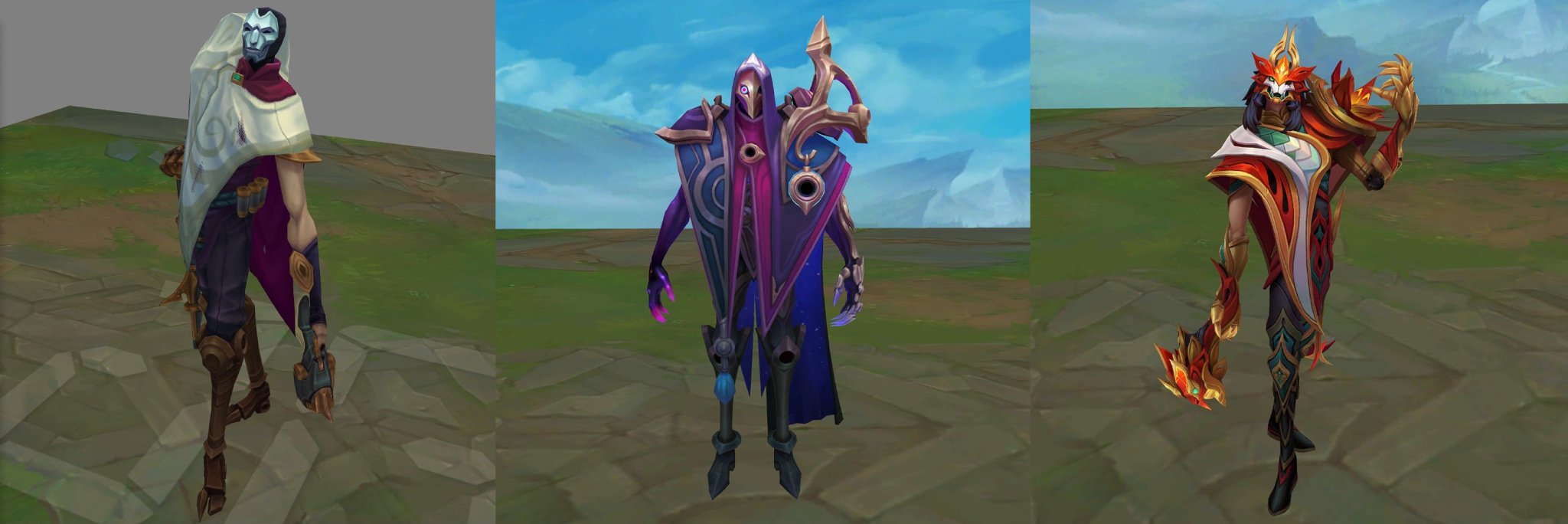
To illustrate this point, let us take the example of the “Dark Cosmic” and “Mythmaker” skins of the champion Jhin, both of “Legendary” tier, compared with the so-called “default” appearance.
The first, “Dark Cosmic” (13 June 2019), is Jhin’s first “Legendary” cosmetic, recognised as one of the game’s greatest cosmetic successes, artistically as well as commercially. Sold for 1,820 RP, or around €15.80, this original character design concept boasts a range of visual and audio features. From simple running animations, known as run animations, to unique textures and animations for each ability, this cosmic theme does not merely adapt the character: it fully integrates the new appearance into the in-game rendering, with each of “Dark Cosmic Jhin”‘s abilities interacting with the effects and modelling of the game map itself. The cosmic theme of the skin wins players over.
The second, “Mythmaker” (23 January 2025), is sold as Jhin’s new “Legendary” skin, dressing him in a fanciful outfit inspired by the myth of the Lunar New Year, drawing on a purist paper-cut aesthetic. “Mythmaker Jhin” is offered at the same price, 1,820 RP, and therefore with the promise of quality worthy of the “Legendary” tier. However, on observing its artistic execution, the opposite is clear. Beyond the adjustment and addition of many textures and particles linked to the chosen theme, all the skeleton (rig) animations are recycled, unchanged from the “default” model. There is also a lack of content on the abilities, the only novelty being a bright colour for the spells. A clear decline in quality, and a further disappointment for loyal players, who see the studio’s quality standards collapsing.
Morgana: an “Exalted” cosmetic for €250
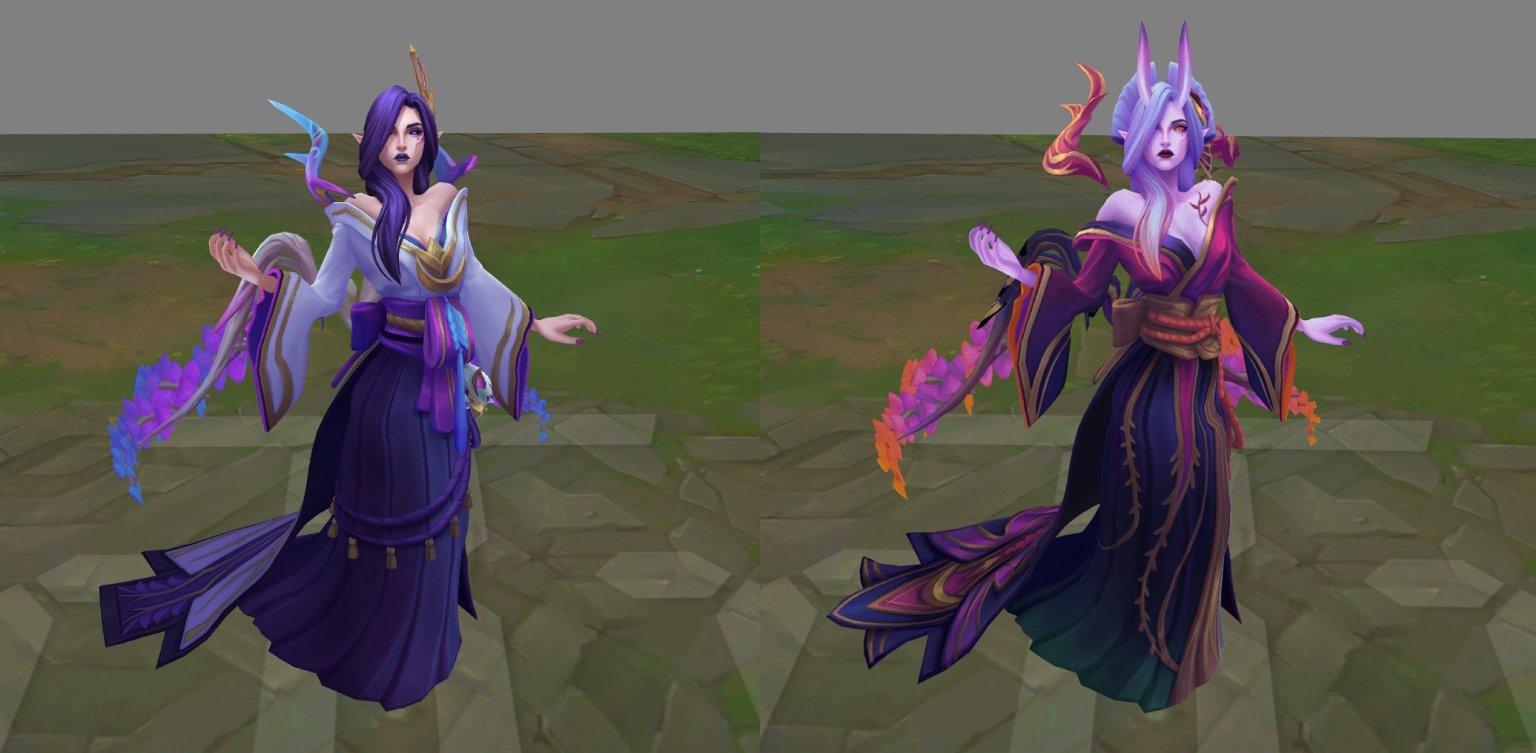
In June 2025, on the Reddit page of Morgana players, questions arose the day after the release of the “Spirit Blossom Morgana” skin on 25 June 2025. Of “Exalted” rarity, it belongs to a higher class than the cosmetics mentioned above. Priced at a real value of 32,000 RP, or around €250, this high-end cosmetic is presented as justified. However, a voice was raised on the very day of its release, describing a series of serious technical and graphical shortcomings in view of its price. A warning that discredited the “Spirit Blossom” cosmetic.
That same voice, tired of being ignored by Riot Games’ customer service, decided to publish its observations. The user, known as LoveForNuWa, described the following shortcomings: the “exalted” cosmetic has numerous defects, bugs and a lack of fluidity, notably “broken” and shaky leg animations, stiff movements out of step with the inertia of the wings and other particles, and a lack of design between the two transformation forms, which look more like a colour change than any variation in 3D modelling. A secondary form which, moreover, suddenly disappears during certain attacks. A range of other interactions seems to be missing, whereas “Legendary” cosmetics offer new and smoother ones.
The user also announced his intention to issue a genuine call to order. LoveForNuWa thus sought to alert the authorities to the studio’s practices, and sent an email to the European Commission to that effect. He described the situation as follows: tired of the gap between the studio’s promises and commercial reality, he found that Riot Games was keeping neither its commitments on its microtransaction policy nor its quality guarantee on new customisation content, including the most expensive items in the League of Legends store. A serious artistic shortcoming which, in his view, amounts to a failure to comply with the standards applicable to digital products and microtransactions, and which should be heard and examined by the competent authorities. At the same time, the user stressed his real intentions: they have no financial motive and take the form neither of an attack nor of a cold criticism of the studio; his approach is that “of a loyal, long-standing customer seeking only to maintain a standard for cosmetics”.
Conclusion
The case study of this Lesson invites players to take a new look at the video game work and to become judges of the microtransaction products they are considering. Like the attentive surgeon of the Lesson, with or without creative intentions, the conscientious player is also encouraged to do so for themselves, to denounce the slackening of rights holders’ artistic missions, or to credit the methods used by their creative peers turned hackers. In this sense, the practice of modding is more a matter of conflict of interest between industry and players. It is not appropriate to expect players to accept an invisible downgrading of content, nor to accept that studios neglect artistic standards, whatever path their content takes. The player-creator is an active collaborator, able to recall the need for regular patching, that is, correction of its composite content. But above all, able to defend the voice of players who care about their purchasing power. “Hacking” video games is, once again, an act of resistance and progressive emancipation of the medium.
Sources
Books and articles
- W. Benjamin, The Work of Art in the Age of Mechanical Reproduction, 1935
- M. Boutet, 2012, p. 212, in P.-Y. Hurel, Le passage du jeu à la création : le cas du jeu vidéo amateur
- J.-P. Fourmentraux, « Art et hacktivisme : l’alternative Internet », Critiques pirates !, 2008, p. 553-564
- M. Wark, Théorie du gamer, Paris, Les Prairies ordinaires, 2019, 209 p., ISBN 978-2-35480-185-4
Artwork
- Rembrandt, The Anatomy Lesson of Dr Nicolaes Tulp, 1632, oil on canvas
Video game
- Riot Games, League of Legends, version 25.23 (November 2025), 2009, directed by Andreu van Roon, Microsoft Windows
https://lexludica.com/en/articles/good-cosmetic-league-of-legends